Arjun Rawat
Himalayan Trek Guide
Uttarakhand is India's trekking capital — over 300 documented trails ranging from 2-day weekend escapes near Delhi to 15-day glacier crossings above 5,000m. But with so many options, choosing the right trek can be overwhelming. This guide covers 7 of the most rewarding and popular treks in the Garhwal and Kumaon Himalayas — one for every kind of trekker, from the first-timer to the experienced mountaineer.
1. Nag Tibba Trek — The Perfect Weekend Trek from Delhi (3,022m)
If you live in Delhi and want a genuine Himalayan summit experience without taking more than a weekend off, Nag Tibba is your answer. At 3,022m in Tehri Garhwal, it is the highest peak of the Lower Himalayas and only 290km from Delhi — a 7-hour drive. The 2-day trail from Pantwari village through deodar and rhododendron forest to the summit offers panoramic views of Bandarpunch, Swargarohini, Kedarnath, and Gangotri peaks.
- Difficulty: Easy | Duration: 2 days | Distance: 16km round trip
- Best season: October–June (snow in December–February)
- Start point: Pantwari village, Tehri Garhwal (290km from Delhi)
- Highlight: 180° panoramic view of the Garhwal Himalaya from the summit
- Perfect for: First-time trekkers, Delhi weekend getaways, families (10+)
Pro Tip
Leave Delhi on Friday night, start trekking Saturday morning, summit Sunday at sunrise, and return to Delhi by Sunday evening. Nag Tibba is the rare trek that fits a working week schedule.
2. Dayara Bugyal Trek — Vast Alpine Meadow at 3,408m (Uttarkashi)
Dayara Bugyal is one of the most photogenic destinations in the Garhwal Himalayas — 28 square kilometres of rolling alpine grassland at 3,408m with 360° views of the Gangotri group of peaks including Bandarpunch (6,316m) and Kala Nag (6,387m). The trek from Barsu or Raithal village (near Uttarkashi) takes 3–4 hours through oak and rhododendron forest — and the meadow has the extraordinary quality of looking equally stunning in summer (green and flowered) and winter (a snow ski field).
- Difficulty: Easy | Duration: 2–3 days | Distance: 9km one way
- Best season: April–June (wildflowers) & October–February (snow skiing)
- Start point: Barsu or Raithal village, Uttarkashi (440km from Delhi)
- Highlight: One of the largest and most beautiful alpine meadows in Garhwal
- Perfect for: Beginner trekkers, photography, winter skiing enthusiasts
Pro Tip
Combine Dayara Bugyal with a Gangotri temple visit — Uttarkashi is the base for both and makes a perfect 4-day itinerary: Delhi → Uttarkashi → Gangotri darshan → Barsu → Dayara Bugyal → Delhi.
3. Brahmatal Trek — Frozen Lake and Snow Camping (3,600m, Chamoli)
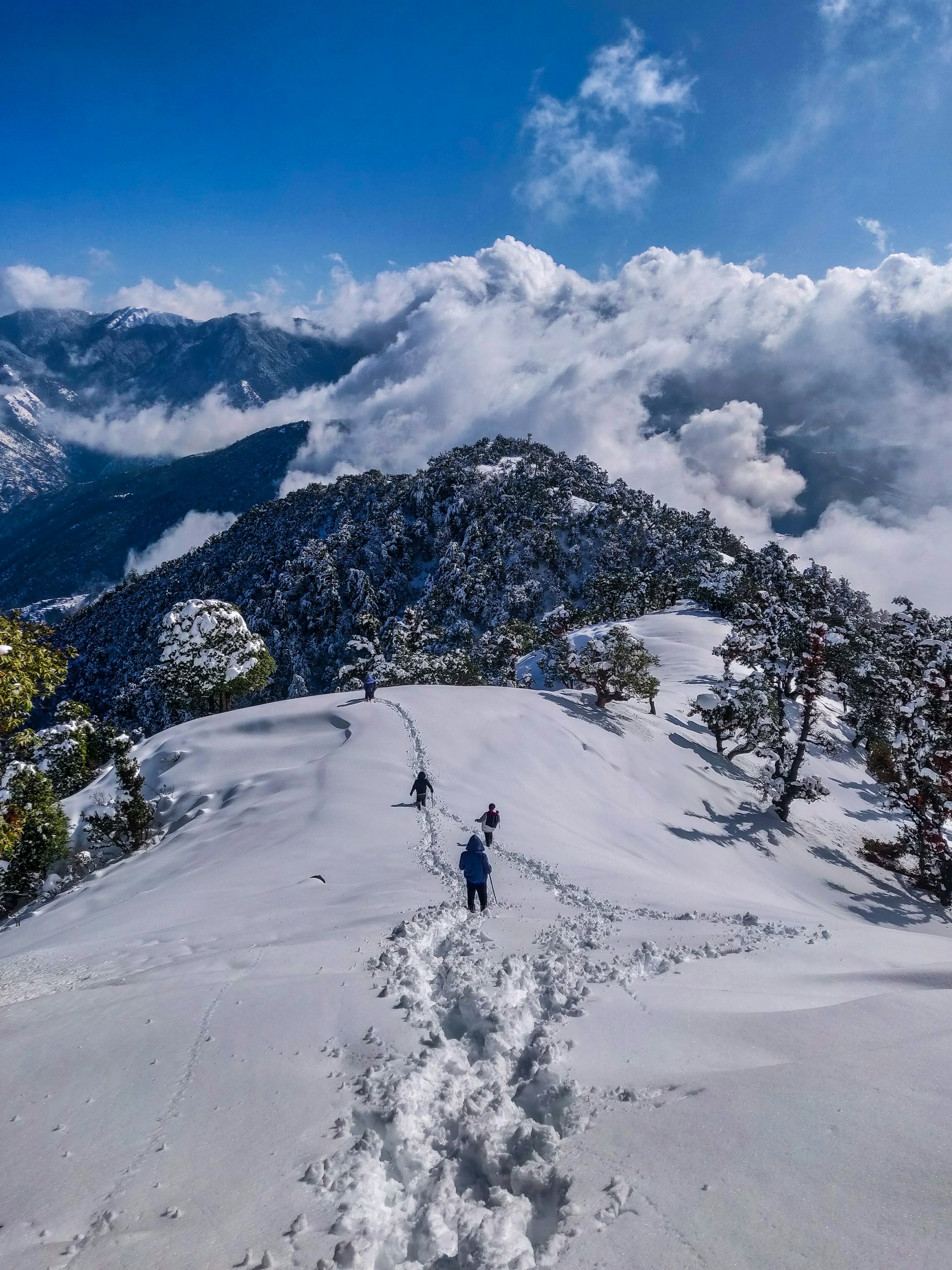
Brahmatal is the definitive winter snow trek for north India — specifically designed for December to March. The frozen Brahmatal lake at 3,600m surrounded by snow-covered rhododendron forest, with Trishul (7,120m) and Nanda Ghunti (6,309m) looming above, creates one of the most visually dramatic trekking experiences in India. Unlike most treks that become dangerous in winter, Brahmatal's snowfall consolidates the trails and the frozen lake becomes a surreal ice mirror that draws trekkers from across India.
- Difficulty: Moderate | Duration: 5 days | Distance: 35km round trip
- Best season: December–March (prime winter snow trek)
- Start point: Lohajung, Chamoli district (520km from Delhi)
- Highlight: Frozen lake at 3,600m surrounded by snow-draped rhododendron forest
- Perfect for: First winter snow trek, photography, experienced weekend trekkers
Important Warning
Brahmatal is a winter trek — visiting in summer or monsoon is underwhelming without snow. The frozen lake and snow-laden forests are what make this trek extraordinary. Book a December–February trip for the full experience.
4. Kuari Pass Trek — Lord Curzon's Trail and Nanda Devi Views (3,640m)
Kuari Pass carries the historical weight of being the route trekked by Viceroy Lord Curzon in 1905, who described the panorama as "the finest mountain view in the world." Standing at 3,640m above sea level, the views from the pass encompass Nanda Devi (7,816m — India's highest entirely within Indian territory), Dronagiri (7,066m), Kamet (7,756m), Hathi Parbat, and Trishul simultaneously. The trek begins from the Auli ski resort — itself a destination — and is equally popular as a winter and summer experience.
- Difficulty: Moderate | Duration: 4–5 days | Distance: 33km round trip
- Best season: December–March (snow trek) & April–June (wildflowers)
- Start point: Auli / Joshimath, Chamoli (500km from Delhi)
- Highlight: Panoramic views of 12+ peaks including Nanda Devi from the pass
- Extension: Pangarchulla Peak (4,700m) — recommended for experienced trekkers
5. Rudranath Trek — 4th Kedar, Remote Shiva Temple (3,600m, Chamoli)
Rudranath is the fourth of the Panch Kedar temples — the circuit of five Shiva shrines in the Garhwal Himalayas — and arguably the most atmospheric. At 3,600m in Chamoli district, the ancient temple where Shiva's mukha (face) is enshrined sits in a hidden valley surrounded by the Panar Bugyal and Pitradhar meadows, with views of Nanda Devi, Trishul, and Panchachuli. Unlike Kedarnath (1st Kedar), Rudranath sees only a trickle of visitors — making it one of the most profound and uncrowded spiritual trekking experiences in India.
- Difficulty: Moderate | Duration: 4 days | Distance: 24km one way from Sagar village
- Best season: May–June & September–October
- Start point: Sagar village, near Gopeshwar, Chamoli (420km from Delhi)
- Highlight: Panar Bugyal meadow views of Nanda Devi and the remote temple atmosphere
- Perfect for: Spiritual trekkers, Panch Kedar circuit pilgrims, adventure seekers
6. Madmaheshwar Trek — 2nd Kedar with Kedarnath Peak Views (3,497m)
Madmaheshwar (3,497m) in Rudraprayag district is the second Panch Kedar shrine where Shiva's navel (nabhi) is worshipped. The trek from Ransi village (near Ukhimath) passes through the lush Bantoli and Kedo meadows before reaching the temple in a setting of extraordinary beauty — with the Kedarnath peak visible from the meadow in a view that many seasoned Himalayan trekkers rate as one of the finest in Garhwal. The nearby Budhha Madmaheshwar (4,000m) extension gives close-up views of the entire Kedarnath massif.
- Difficulty: Moderate | Duration: 4 days | Distance: 24km one way from Ransi
- Best season: May–June & September–October
- Start point: Ransi village, near Ukhimath, Rudraprayag (430km from Delhi)
- Highlight: Kedarnath peak viewed from the meadow — one of the finest views in Garhwal
- Extension: Budhha Madmaheshwar (4,000m) for Chaukhamba panorama
7. Gangotri–Gaumukh–Tapovan — Trek to the Source of the Ganga (4,463m)
If one trek in Uttarakhand deserves the word "epic," it is the Gangotri–Gaumukh–Tapovan. Beginning at the sacred Gangotri temple (3,048m) — itself a Char Dham pilgrimage site — the trail leads 18km through the Gangotri National Park to Gaumukh (3,892m), the glacier snout that is the primary source of the Bhagirathi river (which becomes the Ganga). Continuing beyond Gaumukh across the glacier to Tapovan (4,463m) reveals close-up views of Shivling (6,543m), Bhagirathi peaks, and Meru — peaks ordinarily only seen by mountaineers on expedition.
- Difficulty: Difficult | Duration: 6 days | Distance: 36km round trip (Gangotri–Tapovan)
- Best season: May–June & September–October (no monsoon, no winter)
- Start point: Gangotri, Uttarkashi (490km from Delhi)
- Permit required: Inner Line Permit from DFO Uttarkashi (₹150 Indians, ₹600 foreigners)
- Highlight: Glacier crossing to Tapovan with Shivling close-up — an unforgettable experience
Important Warning
The Gaumukh–Tapovan section involves walking on an active glacier. This requires crampons, a guide, and respect for seracs (ice towers) which can collapse without warning. Do not attempt without a registered local guide who knows the current glacier conditions.
Trek Comparison: Which Trek is Right for You?
Uttarakhand Treks at a Glance
| Trek | Altitude | Difficulty | Duration | Best For |
|---|---|---|---|---|
| Nag Tibba | 3,022m | Easy | 2 days | Beginners, Delhi weekends |
| Dayara Bugyal | 3,408m | Easy | 2–3 days | Photography, skiing |
| Brahmatal | 3,600m | Moderate | 5 days | Winter snow trek |
| Kuari Pass | 3,640m | Moderate | 4–5 days | Best peak views |
| Rudranath | 3,600m | Moderate | 4 days | Spiritual pilgrimage |
| Madmaheshwar | 3,497m | Moderate | 4 days | Kedarnath views |
| Gaumukh–Tapovan | 4,463m | Difficult | 6 days | Glacier adventure |
Essential Tips for All Uttarakhand Treks
- 1Acclimatise before high-altitude treks (above 3,000m) — spend at least one night at an intermediate altitude before ascending.
- 2Hire a registered local guide — not only for safety but for route knowledge, emergency protocols, and cultural insight.
- 3Check permit requirements before your trek — Gangotri National Park and Govind Wildlife Sanctuary require Inner Line Permits.
- 4Pack for weather 10°C colder than forecast — mountain weather changes in 30 minutes.
- 5Carry AMS medication (Diamox) for any trek above 3,000m — consult your doctor before departure.
- 6Leave no trace — all litter must come back down with you. Most treks are in fragile protected wilderness.
- 7Invest in waterproof trekking boots — the single most important gear item for any Himalayan trek.
Best Time to Trek in Uttarakhand
The two main trekking windows are April–June (spring, wildflowers, green landscapes) and September–November (post-monsoon, crystal skies, snow on peaks). December–March is ideal for winter snow treks like Brahmatal, Kuari Pass, and Nag Tibba. July–August is monsoon season — most high-altitude trails become dangerous due to landslides, flooded river crossings, and reduced visibility. A few short, lower-altitude treks remain accessible in monsoon but all glacial routes close.
Pro Tip
September and October are the golden months for Uttarakhand trekking — monsoon has cleared, air is crisp and crystal-clear, wildflowers of the post-monsoon season bloom, and temperatures are comfortable both day and night up to 4,000m.